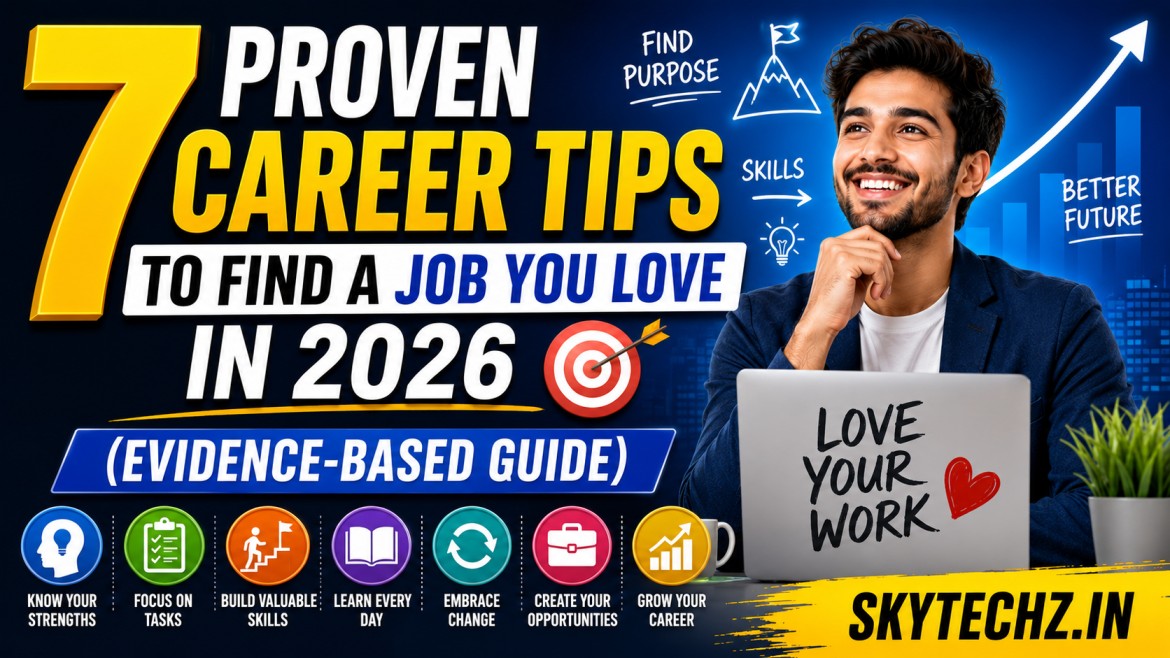
Understanding Career Anxiety and Choosing the Right Path
Choosing the right career has never been easy. In 2026, the job market is evolving faster than ever before. Artificial intelligence, automation, remote work, and digital transformation are changing the skills employers value. While these changes create exciting opportunities, they also leave many people feeling uncertain about their future.
If you’ve ever wondered:
- Am I in the right career?
- Will I enjoy this job five years from now?
- Am I wasting my potential?
- Should I switch careers?
You’re certainly not alone.
Career anxiety affects students, graduates, working professionals, and even experienced employees. The uncertainty of making the “right” career choice often creates stress and self-doubt. Instead of chasing a job title, successful professionals focus on building careers that match their strengths, interests, and daily work preferences. This article explores seven evidence-based strategies to help you create a fulfilling career, inspired by behavioral science concepts discussed in the source transcript.
Why Career Anxiety Is So Common
Most people crave certainty. Unfortunately, careers rarely provide it.
Even after choosing a profession, there is no guarantee that it will remain enjoyable or financially rewarding forever. Many people spend years working toward a prestigious career only to discover they dislike the daily work involved.
Career anxiety usually comes from questions like:
- What if I choose the wrong profession?
- What if I don’t earn enough money?
- What if I never enjoy my work?
- What if everyone else is ahead of me?
These thoughts create pressure that prevents many people from making progress.
The good news is that career satisfaction isn’t about finding the “perfect job.” It’s about continuously learning more about yourself and making better career decisions over time.
Tip #1: Focus on Tasks, Not Job Titles
One of the biggest mistakes people make when choosing a career is falling in love with a job title.
Many people dream about becoming:
- Doctor
- Software Engineer
- Investment Banker
- Lawyer
- Data Scientist
- Entrepreneur
But very few stop to ask an important question:
“What will I actually be doing every day?”
This is one of the most valuable lessons discussed in the transcript. Rather than being attached to a prestigious label or lifestyle, people should evaluate whether they would genuinely enjoy the daily tasks required by that profession.
Job Titles Can Be Misleading
Every profession has glamorous moments.
Social media often shows only the highlights.
For example:
A software developer may seem to spend the day creating exciting apps.
Reality:
- Debugging code
- Fixing bugs
- Writing documentation
- Testing software
- Attending meetings
Similarly, being a doctor sounds prestigious, but the daily routine may include long shifts, paperwork, patient records, emergency situations, and stressful decision-making.
The title looks attractive.
The tasks determine happiness.
Why Daily Work Matters More Than Prestige
Psychological research consistently shows that people perform better when they enjoy what they do regularly.
Think about your average Monday.
Do you enjoy:
- Solving problems?
- Writing?
- Teaching?
- Designing?
- Talking with customers?
- Building products?
- Researching ideas?
Your answers matter much more than whether the job title sounds impressive.
Your career is not defined by your LinkedIn headline.
It is defined by how you spend your day.
The “Pixel Theory” of Career Happiness
A powerful concept mentioned in the transcript is the idea that life is experienced one “pixel” at a time.
Imagine your career as a giant painting.
From far away, the painting looks beautiful.
People admire:
- Your salary
- Your company
- Your job title
- Your office
But you don’t actually live inside the entire painting.
You live inside one tiny pixel.
That pixel represents today’s work.
If today’s work is stressful, boring, or meaningless, the impressive title won’t make you happy.
Real career satisfaction comes from enjoying thousands of ordinary workdays—not just achieving an impressive title.
Questions to Ask Before Choosing Any Career
Instead of asking:
“Is this a prestigious job?”
Ask yourself:
- What does this person actually do every morning?
- Would I enjoy those tasks?
- Would I still enjoy this work after five years?
- What problems would I solve?
- What skills would I use every day?
- Would this work energize me or exhaust me?
These questions provide much better insight than salary alone.
Tip #2: Create Your “Me Plus” Vision
Another practical idea from the transcript is imagining your future self, referred to as “Me Plus.” Instead of focusing only on a dream job title, you define the kind of person you want to become and the work that version of you performs each day.
Think of Me Plus as:
- A wiser version of yourself.
- More skilled.
- More confident.
- More experienced.
- Doing meaningful work.
Now ask yourself:
Where does Me Plus work?
Is it:
- A startup?
- A multinational company?
- A government organization?
- Your own business?
- A remote team?
What responsibilities does Me Plus have?
Maybe you want to:
- Teach others.
- Solve complex problems.
- Build software.
- Create videos.
- Write articles.
- Lead teams.
- Design products.
- Help customers.
Notice that these are tasks—not titles.
That’s exactly the point.
Build Your Career Around Activities You Love
The transcript encourages identifying the kinds of activities that naturally motivate you.
For example, maybe you enjoy:
- Teaching
- Coaching
- Research
- Writing
- Public speaking
- Creativity
- Designing
- Marketing
- Problem solving
- Learning new technology
These interests become clues about the type of career that may suit you best.
Instead of forcing yourself into a career because it looks impressive, build one around work you genuinely enjoy doing.
Over time, this approach often leads to greater satisfaction and stronger long-term performance because your daily work aligns with your natural strengths.
we explored why career anxiety is common, why focusing on daily tasks is more important than chasing prestigious job titles, and how creating your “Me Plus” vision can help you build a fulfilling career.
Now it’s time to take practical action. The next three strategies focus on improving your daily habits, investing in valuable skills, and preparing yourself for long-term career success.
Tip #3: Audit Your Time to Discover What Truly Matters
One of the simplest yet most powerful exercises discussed in the transcript is conducting a time audit. Instead of guessing what you enjoy, take a close look at how you actually spend your days and evaluate which activities move you closer to your career goals.
Many people complain about their jobs without understanding exactly what drains their energy. A time audit helps identify the tasks that motivate you and the ones that leave you feeling exhausted.
How to Perform a Weekly Time Audit
Start by reviewing your calendar or daily schedule for the past week.
For every activity, ask yourself these questions:
- Did I enjoy doing this?
- Did I learn something valuable?
- Did this activity help me grow professionally?
- Would I happily do this again next week?
- Did this bring me closer to the career I want?
You can use a simple rating system:
++ (Excellent): Strongly supports your future career.
+ (Good): Somewhat beneficial.
± (Neutral): Neither helps nor hurts.
– (Negative): Drains your energy.
–– (Very Negative): Moves you away from your goals.
After one or two weeks, patterns begin to appear.
You may discover that:
- You enjoy writing reports.
- You like solving technical problems.
- Teaching others excites you.
- Endless meetings frustrate you.
- Administrative work feels repetitive.
These insights are extremely valuable because they reveal what type of work naturally fits your personality.
Reduce Energy-Draining Activities
Once you’ve identified your “minus” activities, your next goal is to reduce them whenever possible.
For example:
Instead of spending hours on repetitive manual work, can you automate part of it?
Instead of accepting every unnecessary meeting, can you communicate through email or project management tools?
Small improvements made consistently over time can dramatically improve job satisfaction.
Even if you cannot change your current job immediately, understanding what drains your energy helps you make smarter career decisions in the future.
Tip #4: Invest Just 13 Minutes a Day
One of the most encouraging ideas from the transcript is that meaningful career growth doesn’t require several hours every day.
Instead, the recommendation is to dedicate 90 minutes each week—roughly 13 minutes per day—to developing yourself.
Thirteen minutes may not sound like much, but consistency creates remarkable results over time.
This principle is known as compounding.
Just as money grows through compound interest, your skills grow through consistent learning.
Imagine spending only 13 minutes every day learning:
- Artificial Intelligence
- Digital Marketing
- Graphic Design
- Data Analytics
- Video Editing
- Coding
- Copywriting
- Public Speaking
After one year, you’ll have invested more than 75 hours in building valuable skills.
That’s enough time to complete several online courses, build personal projects, and strengthen your portfolio.
Small Daily Improvements Lead to Big Results
Many people postpone learning because they believe they need several free hours every day.
In reality, progress happens through small, consistent actions.
For example:
- Read five pages of a business book.
- Watch a short educational video.
- Complete one lesson in an online course.
- Practice a programming exercise.
- Write one blog post.
- Improve your LinkedIn profile.
- Learn one new software shortcut.
None of these tasks take very long, but together they create significant long-term growth.
Successful professionals understand that consistent improvement always beats occasional bursts of motivation.
Build Career Capital
The transcript also introduces the concept of career capital—the collection of valuable skills, knowledge, and experience that make you more attractive to employers.
Rather than waiting for your dream job to appear, focus on becoming someone companies want to hire.
Career capital includes:
- Technical expertise
- Communication skills
- Leadership ability
- Problem-solving
- Creativity
- Project management
- Industry knowledge
The stronger your career capital becomes, the more opportunities you create for yourself.
High-paying careers are rarely built overnight.
They are earned through continuous skill development.
Learn Skills That Employers Actually Need
In today’s competitive job market, employers increasingly value practical skills over theoretical knowledge.
Some of the most valuable career skills in 2026 include:
- AI tools and automation
- Cloud computing
- Cybersecurity
- Digital marketing
- SEO
- Content creation
- UI/UX design
- Data visualization
- Programming
- Financial analysis
These skills can often be learned through online courses, certifications, personal projects, and hands-on practice.
The key is to focus on becoming genuinely good at solving real-world problems.
Tip #5: You Don’t Always Need Another Degree
Many professionals believe the answer to career growth is going back to university.
However, the transcript encourages people to think carefully before committing to another expensive degree, especially if they’re unsure about their career direction. Instead, it suggests exploring affordable or free learning resources first.
This doesn’t mean college has no value.
For many people, a university education provides an excellent foundation.
But if your goal is simply to learn a new skill, there are now countless alternatives.
These include:
- Online learning platforms
- Professional certifications
- Industry workshops
- Books
- Podcasts
- YouTube tutorials
- Community forums
- Practical projects
Many employers care more about what you can do than where you learned it.
Experience Often Beats Credentials
Imagine two candidates applying for the same position.
Candidate A:
- Several certificates
- Limited practical experience
Candidate B:
- Real-world projects
- Strong portfolio
- Proven results
In many industries, Candidate B has a competitive advantage.
That’s why building projects, volunteering, freelancing, or contributing to open-source communities can be just as valuable as earning another qualification.
The goal isn’t simply to collect certificates.
The goal is to develop skills you can confidently demonstrate.
we learned how auditing your time, investing just 13 minutes each day in learning, and building career capital can help create long-term success.
The final two strategies focus on something many professionals fear—change. The modern workplace evolves rapidly, and adapting to new opportunities is often the key to building a fulfilling career.
Tip #6: Don’t Be Afraid to Make Career U-Turns
Many people believe that changing careers means they have failed.
In reality, changing direction is often a sign of growth.
One of the key messages from the transcript is that people naturally change over time. Our interests, values, priorities, and goals evolve, so it is completely normal for career preferences to change as well.
Think about your own life.
The career you wanted at age 16 may not be the career you want today.
Your experiences, skills, and personal goals have likely changed.
That doesn’t mean your earlier decision was wrong.
It simply means you’ve learned more about yourself.
Your Future Self Will Think Differently
Behavioral science suggests that humans consistently underestimate how much they will change in the future. The transcript references this idea to explain why many people stay in careers that no longer fit them—they assume today’s preferences will remain permanent, even though they often won’t.
Someone might begin their career because they value:
- Job security
- Salary
- Prestige
Ten years later, they may care more about:
- Flexible work
- Family time
- Creativity
- Entrepreneurship
- Purpose
There is nothing wrong with changing priorities.
Career development is not a straight line.
Successful People Adapt
Many successful entrepreneurs, executives, creators, and business owners have changed careers multiple times.
Some examples include people who started as:
- Teachers
- Engineers
- Doctors
- Journalists
- Designers
Before becoming founders, consultants, speakers, or content creators.
The important lesson is not to avoid change.
The important lesson is to make thoughtful decisions based on new information and experience.
Every career teaches valuable skills that can help you in the next stage of your journey.
Learn Instead of Feeling Stuck
Whenever you’re unsure about your career, ask yourself:
- What have I learned?
- Which skills have I gained?
- What work gives me energy?
- What work drains my motivation?
Instead of viewing a career change as failure, treat it as collecting data.
Each experience teaches you something valuable about the type of work you genuinely enjoy.
Tip #7: Use the Grid Search Method
One of the most practical ideas in the transcript is the Grid Search Method. Rather than waiting for the perfect career to appear, it encourages trying different activities, learning from each experience, and gradually discovering the work that fits you best.
Instead of asking:
“What’s my dream career?”
Ask:
“What activities do I enjoy?”
This small shift can completely change how you approach career planning.
Discover Patterns in Your Interests
Take a notebook and list activities you’ve enjoyed throughout your life.
For example:
- Teaching
- Writing
- Designing
- Coding
- Public speaking
- Photography
- Video editing
- Marketing
- Helping people
- Research
- Selling
- Managing projects
Now look for patterns.
Perhaps you’ve always enjoyed explaining ideas.
Maybe you’ve always enjoyed solving technical problems.
Perhaps you’ve always enjoyed creating things.
These recurring interests often reveal the direction your career should take.
Connect the Dots Looking Back
One fascinating observation from the transcript is that career paths often make sense only when we look back.
At the time, each step may seem unrelated.
Later, everything connects.
Someone might have:
- Enjoyed teaching in school.
- Started mentoring colleagues.
- Created educational videos.
- Eventually became a successful online educator.
None of those steps seemed connected at first.
But together, they formed a meaningful career.
Your own journey may work the same way.
Instead of worrying about having every answer today, focus on taking the next useful step.
Keep Experimenting
Treat your career like an experiment.
Try new experiences such as:
- Freelancing
- Internships
- Side projects
- Volunteering
- Online courses
- Networking events
- Industry conferences
- Personal blogs
- YouTube channels
- Open-source projects
Every experience teaches something.
Even if one opportunity isn’t the right fit, you’ve gained valuable knowledge that will improve your next decision.
Practical Action Plan for 2026
If you want to build a career you genuinely enjoy, start with these practical steps:
Week 1
- Write down your long-term career vision.
- Identify your favorite daily activities.
- Define your “Me Plus” version.
Week 2
- Complete a full time audit.
- Remove one unnecessary activity.
- Replace it with skill development.
Week 3
- Spend at least 13 minutes each day learning a valuable skill.
- Complete your first online certification or mini-project.
Week 4
- Update your resume and LinkedIn profile.
- Build a portfolio showcasing your work.
- Connect with professionals in your target industry.
Repeat this process every month.
Small improvements lead to significant career growth over time.
Common Career Mistakes to Avoid
Many professionals delay their progress by making avoidable mistakes.
Try to avoid:
- Choosing prestige over happiness.
- Comparing your journey to others.
- Waiting for perfect opportunities.
- Ignoring your natural strengths.
- Refusing to change direction.
- Stopping your learning after graduation.
- Believing success happens overnight.
The most successful people remain curious and continue improving throughout their careers.
Final Thoughts
Building a career you love isn’t about finding a perfect job on your first attempt. It’s about understanding yourself, identifying the work that energizes you, developing valuable skills, and being willing to adjust your path as you learn more.
The ideas explored throughout this guide encourage a practical approach: focus on the tasks you enjoy, create a vision for your future self, regularly evaluate how you spend your time, invest consistently in learning, and stay open to thoughtful career changes as your interests evolve.
Every successful career is built one decision at a time.
You don’t need to have everything figured out today.
Start with one small action.
Learn one new skill.
Improve one habit.
Take one step toward your future.
Years from now, you’ll be able to look back and realize those small decisions created the career you’ve always wanted.
Frequently Asked Questions (FAQ)
1. How can I choose the right career in 2026?
Focus on the daily tasks you enjoy rather than job titles. Build skills that match your strengths and continue learning as industries evolve.
2. Is it okay to change careers?
Yes. Career changes are a normal part of professional growth. As your interests and priorities evolve, changing direction can help you find more meaningful work.
3. Do I need another college degree?
Not always. Many valuable skills can be learned through online courses, certifications, books, practical projects, and real-world experience.
4. What skills should I learn for future careers?
AI tools, digital marketing, programming, data analysis, communication, problem-solving, leadership, and project management are among the most valuable skills for the future.
5. What’s the biggest career advice from this guide?
Stop chasing impressive job titles. Instead, build a career around work you genuinely enjoy doing every day while continuously improving your skills.