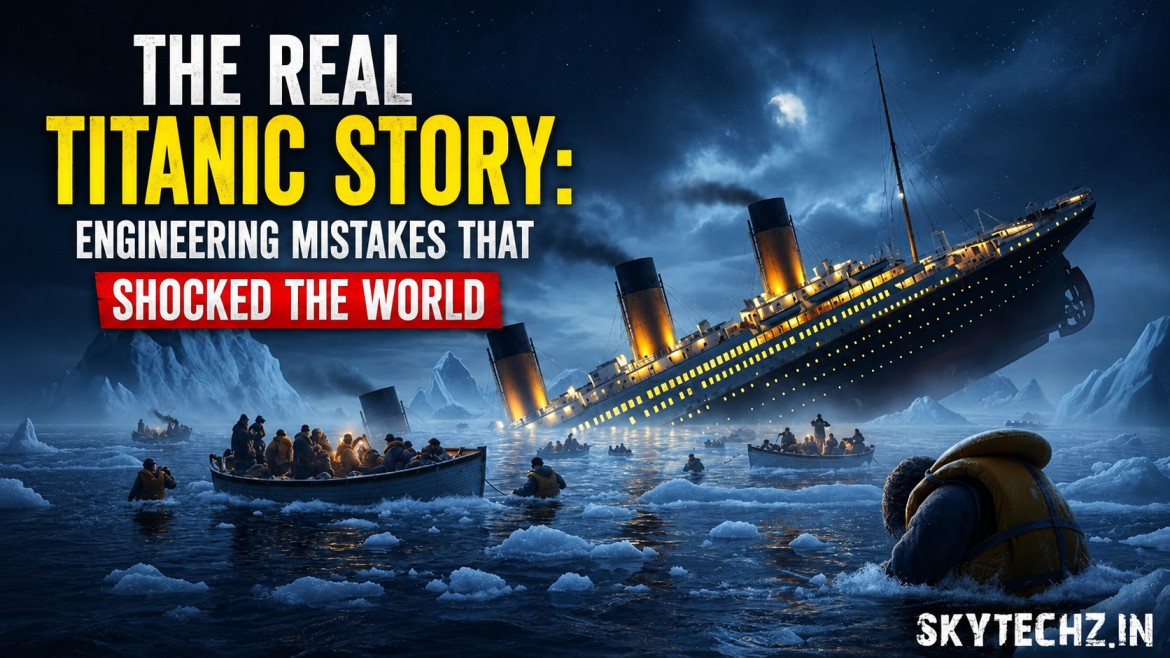
The Real Titanic Story
More than a century has passed since the Titanic disappeared beneath the freezing waters of the North Atlantic, yet its story continues to fascinate millions around the world.
How could the largest and most luxurious ship of its time sink on its very first voyage?
How did a vessel that took nearly 1,200 days to build disappear beneath the ocean in less than three hours?
The answer lies in a series of human errors, engineering decisions, and unfortunate circumstances.
Many people believe the iceberg alone caused the disaster. However, historians and maritime experts agree that the iceberg was only the final trigger. A chain of critical mistakes made long before the collision played a much bigger role.
In this article, we’ll explore the six biggest mistakes that contributed to the sinking of the Titanic while separating historical facts from popular myths.
The Real Titanic Story:The Birth of the World’s Most Luxurious Ship
Construction of the Titanic began in 1909 at the Harland & Wolff shipyard in Belfast after planning started in 1907.
It took approximately:
- Over 15,000 workers during construction
- Nearly 1,200 days of planning and building
- Millions of dollars in investment
- Thousands of tons of steel
At the time, Titanic was considered an engineering masterpiece.
Its impressive features included:
- Length of 882 feet
- Height of 175 feet
- Weight of over 46,000 tons
- Luxury dining halls
- Swimming pool
- Gymnasium
- Grand staircase
- Electric elevators
- Wireless communication system
The ship was marketed as one of the safest passenger liners ever built.
Although it was never officially advertised as “unsinkable” by the builders in absolute terms, widespread publicity created the impression that it was exceptionally safe.
The Real Titanic Story The Maiden Voyage Begins
On April 10, 1912, Titanic departed from Southampton, England.
Its destination was New York City.
The voyage attracted worldwide attention because it carried:
- Wealthy businessmen
- Celebrities
- Immigrants seeking new lives
- Families
- Crew members
More than 2,200 people were on board, including passengers and crew.
No one imagined the journey would become one of history’s greatest maritime disasters.
Mistake #1: Pressure to Maintain High Speed
The first major mistake happened before the ship even reached the open Atlantic.
Titanic’s owners wanted the maiden voyage to be a success.
Arriving on schedule would strengthen public confidence and create positive publicity.
As a result, the ship maintained a relatively high cruising speed despite entering waters where icebergs were known to exist.
Although Titanic was capable of speeds above 23 knots, continuing at high speed in dangerous conditions reduced the crew’s reaction time dramatically.
When visibility decreases, slower speeds provide more time to detect and avoid obstacles.
Unfortunately, Titanic did the opposite.
Mistake #2: Iceberg Warnings Were Not Properly Prioritized
During April 14, multiple nearby ships transmitted wireless warnings about drifting icebergs.
These warnings informed Titanic that dangerous ice fields were directly along its route.
Several messages reached the wireless operators.
However, many operators were busy sending passengers’ personal telegrams to shore.
As a result, some iceberg warnings were delayed, overlooked, or never reached Captain Edward Smith promptly.
Had every warning been treated with maximum urgency, the ship could have:
- Changed course
- Reduced speed
- Increased lookout measures
This missed opportunity became one of the biggest failures of communication in maritime history.
Mistake #3: Lookouts Had No Binoculars
Perhaps one of the most surprising facts about Titanic involves its lookouts.
The men stationed in the crow’s nest were responsible for spotting dangers ahead.
However, they were working without binoculars.
A last-minute crew change meant the key containing the binocular cabinet was unavailable, leaving the lookouts to rely only on their eyesight.
On a dark, calm night, icebergs are extremely difficult to detect because calm water creates very little wave activity around the ice.
By the time the lookout finally spotted the iceberg, it was already too close.
Only seconds remained.
That was not enough.
Mistake #4: Structural Weaknesses Increased the Damage
The collision itself did not tear a massive hole through Titanic.
Instead, the iceberg scraped along the ship’s starboard side.
The impact damaged multiple sections of the hull.
Some researchers believe certain rivets used in portions of the ship contained lower-quality wrought iron instead of stronger steel, making them more vulnerable under extreme stress.
While historians continue debating the exact extent of this issue, many experts agree that the collision opened several compartments, allowing seawater to flood the ship.
Titanic was designed to survive flooding in a limited number of watertight compartments.
Unfortunately, too many compartments were breached.
Once water spilled over from one compartment into the next, the ship’s fate was effectively sealed.
Mistake #5: Not Enough Lifeboats
This remains one of the most tragic aspects of the disaster.
Titanic carried lifeboats for only about half the people on board.
Although the number technically met outdated British maritime regulations at the time, those regulations had not kept pace with the size of modern passenger ships.
The ship had room for additional lifeboats.
However, fewer were installed due to a combination of regulations, aesthetics, and assumptions that the ship itself was extremely safe.
When evacuation began, there simply were not enough seats for everyone.
Thousands of lives depended on a limited number of boats.
Mistake #6: Lifeboats Left Partially Empty
Even among the available lifeboats, another mistake occurred.
During the chaotic evacuation:
- Many passengers hesitated to leave the large ship.
- Crew members feared overloading boats.
- Confusion spread across different sections.
As a result, several lifeboats launched with dozens of empty seats.
Later investigations estimated that many additional people could have survived if those boats had been filled closer to capacity.
The evacuation lacked consistent organization, costing precious lives.
The Final Moments
At approximately 11:40 PM on April 14, 1912, Titanic struck the iceberg.
Water began flooding the forward compartments almost immediately.
Captain Edward Smith quickly realized the seriousness of the situation.
Distress signals were transmitted through wireless radio.
Nearby ships responded, but none arrived in time.
As flooding increased:
- Electricity gradually failed.
- Lights eventually went out.
- The bow sank deeper into the freezing Atlantic.
Eventually, the enormous stress caused the ship to break apart before disappearing beneath the ocean.
The entire sinking lasted approximately 2 hours and 40 minutes.
The Deadly Atlantic Waters
The water temperature was around −2°C (28°F).
Even strong swimmers had little chance of survival.
Cold shock and hypothermia could overwhelm a person within minutes.
Although many people escaped the sinking ship, the freezing water became another deadly obstacle.
Rescue ships later recovered only a fraction of those who entered the ocean.
Casualties
Approximately:
- Around 2,224 people were aboard.
- About 1,500 people lost their lives.
- Roughly 700 survived.
Women and children had significantly higher survival rates because of the “women and children first” evacuation policy, although many exceptions occurred during the confusion.
Captain Edward Smith’s Final Hours
Captain Edward Smith had decades of maritime experience.
Throughout the evacuation, witnesses reported seeing him helping passengers and crew.
His exact final moments remain uncertain because eyewitness accounts differ.
What is widely accepted is that he remained aboard during the final stages of the disaster and died when the ship sank.
Lessons the World Learned
The Titanic disaster permanently changed maritime safety.
Following the tragedy, several major improvements were introduced worldwide:
Lifeboats for Everyone
Passenger ships must now carry enough lifeboats for every person aboard.
Continuous Radio Watch
Wireless operators now maintain continuous emergency monitoring.
International Ice Patrol
Special patrols monitor iceberg movements in the North Atlantic and warn ships of potential dangers.
Better Safety Drills
Passenger vessels conduct regular evacuation exercises and emergency preparedness training.
Improved Ship Design
Modern ships feature stronger hulls, advanced navigation systems, radar, satellite communication, GPS, and stricter international safety standards.
Myths About Titanic
Myth: Titanic was officially called “unsinkable.”
Not exactly. While promotional materials emphasized its advanced safety features, the absolute claim that it could never sink became exaggerated through media coverage and public perception.
Myth: The iceberg alone caused the disaster.
The iceberg was only the immediate cause. Human decisions, communication failures, design limitations, and evacuation problems all contributed significantly.
Myth: Everyone in first class survived.
Many wealthy passengers survived, but numerous first-class travelers also lost their lives.
Final Thoughts
The sinking of the Titanic remains one of history’s most studied disasters because it wasn’t caused by a single mistake. Instead, it resulted from a chain of preventable decisions—high speed in icy waters, missed iceberg warnings, limited visibility, structural vulnerabilities, too few lifeboats, and a disorganized evacuation.
More than a century later, the tragedy continues to shape modern maritime safety standards and serves as a powerful reminder that overconfidence, poor communication, and small oversights can have catastrophic consequences.