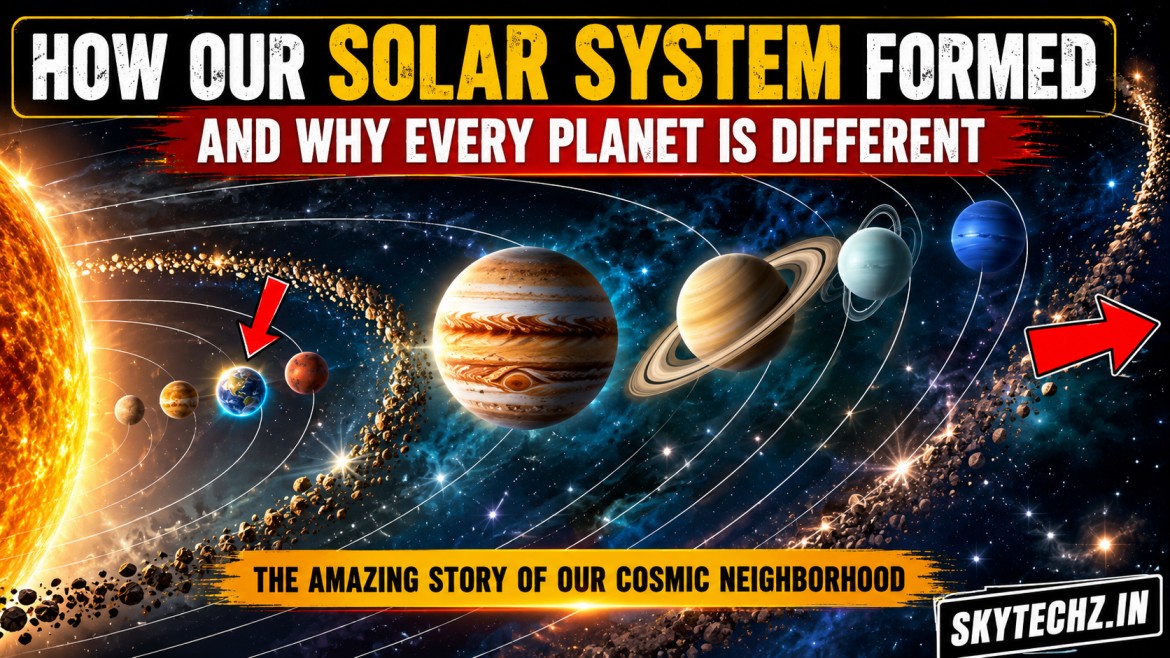
Have you ever wondered how our Solar System was created? Why is Earth the only known planet with life? Why are some planets made of rock while others are giant balls of gas?
Our Solar System is one of the most fascinating places in the universe. It contains the Sun, eight planets, hundreds of moons, dwarf planets, asteroids, comets, and billions of icy objects. Every planet has its own unique features, atmosphere, temperature, and mysteries waiting to be explored.
In this beginner-friendly guide, you’ll learn how the Solar System formed and discover amazing facts about every planet in simple English.
What Is the Solar System?
The Solar System is a family of celestial objects that orbit the Sun because of its powerful gravitational force.
It includes:
- The Sun
- Eight planets
- More than 290 known moons
- Dwarf planets
- Asteroids
- Comets
- Meteoroids
- The Asteroid Belt
- The Kuiper Belt
The Sun is the center of the Solar System and contains more than 99.8% of the system’s total mass. Without its gravity, the planets would drift away into deep space.
How Was the Solar System Formed?
Scientists believe the Solar System formed about 4.6 billion years ago from a massive cloud of gas and dust known as the Solar Nebula.
As gravity pulled this cloud together, nearly all of the material gathered at the center and formed the Sun.
The remaining gas and dust slowly collided and stuck together, creating larger objects called planetesimals. Over millions of years, these objects grew into planets, moons, asteroids, and comets.
Eventually, everything settled into stable orbits around the Sun, forming the Solar System we know today.
The Eight Planets of Our Solar System
The planets are arranged according to their distance from the Sun.
- Mercury
- Venus
- Earth
- Mars
- Jupiter
- Saturn
- Uranus
- Neptune
The first four planets are called rocky or terrestrial planets, while the last four are known as gas and ice giants.
Mercury – The Smallest Planet
Mercury is the closest planet to the Sun and the smallest planet in our Solar System.
Quick Facts
- Distance from the Sun: About 58 million km
- Diameter: 4,879 km
- Moons: None
- Length of a Year: 88 Earth days
Mercury has almost no atmosphere, so it cannot trap heat. During the day, temperatures can reach about 430°C, while at night they can fall below −180°C.
Scientists have discovered frozen water ice inside permanently shadowed craters near Mercury’s poles, despite its extreme daytime heat.
Mercury rotates very slowly. One day on Mercury lasts approximately 59 Earth days.
Venus – The Hottest Planet
Although Mercury is closest to the Sun, Venus is actually the hottest planet in the Solar System.
Quick Facts
- Distance from the Sun: About 108 million km
- Diameter: 12,104 km
- Moons: None
- Average Temperature: 465°C
Venus is often called Earth’s Twin because it is almost the same size as Earth.
However, its atmosphere is made mostly of carbon dioxide, creating an extreme greenhouse effect that traps enormous amounts of heat.
The clouds of Venus contain sulfuric acid, making the planet one of the most dangerous places in the Solar System.
Unlike most planets, Venus rotates in the opposite direction. As a result, the Sun appears to rise in the west and set in the east.
Another fascinating fact is that one day on Venus lasts 243 Earth days, while one year lasts only 225 Earth days.
Earth – Our Blue Planet
Earth is the third planet from the Sun and the only known planet that supports life.
Quick Facts
- Distance from the Sun: About 150 million km
- Diameter: 12,742 km
- Moons: One
- Surface Covered by Water: About 71%
Earth has all the essential conditions needed for life, including liquid water, oxygen-rich air, moderate temperatures, a protective ozone layer, and a strong magnetic field.
These unique conditions make Earth different from every other known planet.
Why Is Earth Special?
- Located in the habitable zone around the Sun.
- Has abundant liquid water.
- Protected by a strong magnetic field.
- Atmosphere blocks harmful solar radiation.
- The Moon helps stabilize Earth’s rotation and creates ocean tides.
Because of these unique features, Earth remains the only confirmed planet known to support life.
Rocky Planets vs Gas Giants
The first four planets—Mercury, Venus, Earth, and Mars—have solid rocky surfaces and are known as terrestrial planets.
The outer planets—Jupiter, Saturn, Uranus, and Neptune—are much larger and are mostly made of hydrogen, helium, methane, and other gases. These giant planets do not have a solid surface where humans can stand.
Mars – The Red Planet
Mars is the fourth planet from the Sun and is one of the most studied planets in our Solar System. Scientists believe it is the best candidate for future human exploration because it has seasons, polar ice caps, and evidence that liquid water once flowed across its surface.
Quick Facts
- Distance from the Sun: About 228 million km
- Diameter: 6,779 km
- Moons: 2 (Phobos and Deimos)
- Length of a Year: 687 Earth days
Mars is called the Red Planet because its surface contains large amounts of iron oxide, commonly known as rust.
Scientists have discovered dried riverbeds, ancient lakes, and frozen water at the poles. Modern space missions continue searching for signs of past microbial life and underground water.
Mars is also home to Olympus Mons, the largest volcano in the Solar System. It stands about 22 kilometers high, nearly three times taller than Mount Everest.
Although humans cannot survive there without advanced equipment, Mars remains the most promising planet for future space colonies.
Jupiter – The King of the Planets
Jupiter is the largest planet in the Solar System. It is so massive that all the other planets combined are still smaller than Jupiter.
Quick Facts
- Distance from the Sun: About 778 million km
- Diameter: 139,820 km
- Known Moons: 95
- Length of a Day: About 10 hours
Unlike Earth, Jupiter does not have a solid surface. It is mainly made of hydrogen and helium gases.
One of Jupiter’s most famous features is the Great Red Spot, a giant storm that has been raging for hundreds of years. The storm is so large that Earth could fit inside it.
Jupiter’s powerful gravity protects the inner planets by attracting many asteroids and comets that might otherwise collide with Earth. Because of this, it is often called the “Vacuum Cleaner of the Solar System.”
One of Jupiter’s moons, Europa, is believed to contain a vast ocean beneath its icy surface, making it one of the best places to search for extraterrestrial life.
Saturn – The Ringed Planet
Saturn is the second-largest planet in the Solar System and is famous for its beautiful ring system.
Quick Facts
- Distance from the Sun: About 1.43 billion km
- Diameter: 116,460 km
- Known Moons: 146
- Length of a Day: About 10.7 hours
Saturn’s rings are made of billions of pieces of ice, rock, and dust that orbit the planet.
Although Saturn is enormous, it has a very low density. Scientists estimate that if there were an ocean large enough, Saturn would float on it.
One of Saturn’s largest moons, Titan, has a thick atmosphere and lakes filled with liquid methane, making it one of the most interesting worlds in our Solar System.
Uranus – The Tilted Planet
Uranus is the seventh planet from the Sun and is known for its unusual rotation.
Quick Facts
- Distance from the Sun: About 2.9 billion km
- Diameter: 50,724 km
- Known Moons: 28
- Average Temperature: Around −224°C
Unlike every other planet, Uranus rotates almost on its side with a tilt of about 98 degrees.
Scientists believe a massive collision long ago may have knocked Uranus into this unusual position.
The planet is mostly made of water, ammonia, and methane ices, giving it a pale blue-green appearance.
Neptune – The Farthest Planet
Neptune is the eighth and most distant planet in our Solar System.
Quick Facts
- Distance from the Sun: About 4.5 billion km
- Diameter: 49,244 km
- Known Moons: 16
- Length of a Year: About 165 Earth years
Neptune is famous for having the fastest winds in the Solar System, reaching speeds of more than 2,000 km/h.
Its beautiful blue color comes from methane gas in its atmosphere.
Scientists believe the extreme pressure deep inside Neptune may create tiny diamonds that slowly fall toward the planet’s core, often described as “diamond rain.”
Because Neptune is so far away, sunlight takes more than four hours to reach it from the Sun.
What Happened to Pluto?
For many years, students learned that our Solar System had nine planets. Pluto was considered the ninth planet after its discovery in 1930.
However, in 2006 the International Astronomical Union (IAU) introduced a new definition of a planet. Pluto did not meet all the required conditions because it has not cleared other objects from its orbit.
As a result, Pluto was reclassified as a dwarf planet. Although it is no longer considered one of the eight major planets, it remains one of the most fascinating objects in our Solar System.
The Asteroid Belt
Between the orbits of Mars and Jupiter lies the Asteroid Belt, a region filled with millions of rocky objects of different sizes.
Some asteroids are only a few meters wide, while others are hundreds of kilometers across. Scientists believe these rocky bodies are leftover building materials from the formation of the Solar System.
Although movies often show the Asteroid Belt as crowded, the asteroids are actually separated by huge distances, making collisions relatively rare.
The Kuiper Belt
Beyond Neptune lies another fascinating region called the Kuiper Belt.
This distant area contains countless icy objects, dwarf planets, and comets. Pluto is one of the largest known objects in the Kuiper Belt.
Many short-period comets that visit the inner Solar System are believed to originate from this icy region.
Can Humans Live on Other Planets?
At present, Earth is the only known planet that naturally supports human life.
Mars is considered the most promising destination for future human missions because it has water ice, seasons, and a day length similar to Earth’s.
However, Mars has a thin atmosphere, freezing temperatures, and harmful radiation. Humans would need advanced habitats, oxygen systems, and reliable food production to survive there.
Scientists continue researching ways to establish permanent human settlements on Mars, but for now, Earth remains our safest and most comfortable home.
Interesting Solar System Facts
- The Sun contains more than 99.8% of the Solar System’s total mass.
- Mercury has no natural moons.
- Venus is hotter than Mercury despite being farther from the Sun.
- Earth is the only known planet with life.
- Mars has the tallest volcano in the Solar System, Olympus Mons.
- Jupiter has the strongest magnetic field of any planet.
- Saturn has the most spectacular ring system.
- Uranus rotates on its side.
- Neptune experiences the fastest winds in the Solar System.
- Light from the Sun takes about 8 minutes and 20 seconds to reach Earth.
Frequently Asked Questions (FAQs)
How many planets are in the Solar System?
There are eight officially recognized planets in the Solar System.
Which is the largest planet?
Jupiter is the largest planet in the Solar System.
Which is the hottest planet?
Venus is the hottest planet because its thick carbon dioxide atmosphere traps heat.
Why is Mars called the Red Planet?
Mars appears red because its surface contains iron oxide, commonly known as rust.
Can humans live on Mars today?
Not yet. Future technology may allow humans to live there, but significant challenges remain.
Why is Pluto no longer a planet?
Pluto was classified as a dwarf planet in 2006 because it does not meet all the requirements for being a full-sized planet.
Conclusion
Our Solar System is an incredible cosmic neighborhood filled with rocky planets, giant gas worlds, icy giants, moons, asteroids, and mysterious dwarf planets. Every planet has unique characteristics that help scientists understand how the universe works.
While space exploration has revealed many amazing discoveries, countless mysteries still remain. Future missions and advanced technology will continue expanding our knowledge of the Solar System and perhaps even answer one of humanity’s greatest questions—whether life exists beyond Earth.
Until then, our beautiful blue planet remains the only known home for life and one of the most extraordinary worlds in the universe.
Thank you for reading! If you enjoyed this guide, share it with your friends and keep exploring the amazing wonders of our Solar System.