Why Do Coconut Trees Grow Near the Sea? The Amazing Science Behind Nature’s Perfect Survivor
Have you ever noticed that wherever there is a beach—whether it’s Goa, Mangalore, Sri Lanka, the Maldives, or Hawaii—you almost always find coconut trees standing tall along the coastline?
Many people believe coconut trees survive by drinking salty seawater. However, this is one of the biggest myths about coconut trees.
The truth is much more fascinating. Coconut trees are among nature’s most successful coastal plants. Over millions of years, they evolved unique survival techniques that allow them to thrive where many other plants cannot. From floating across oceans to growing on sandy beaches, coconut trees are a remarkable example of nature’s engineering.
Do Coconut Trees Really Drink Seawater?
The answer is No.
Although coconut trees grow close to the ocean, they do not survive by drinking seawater.
Like most plants, coconut trees need fresh water to grow. Too much salt can damage roots and prevent plants from absorbing nutrients properly.
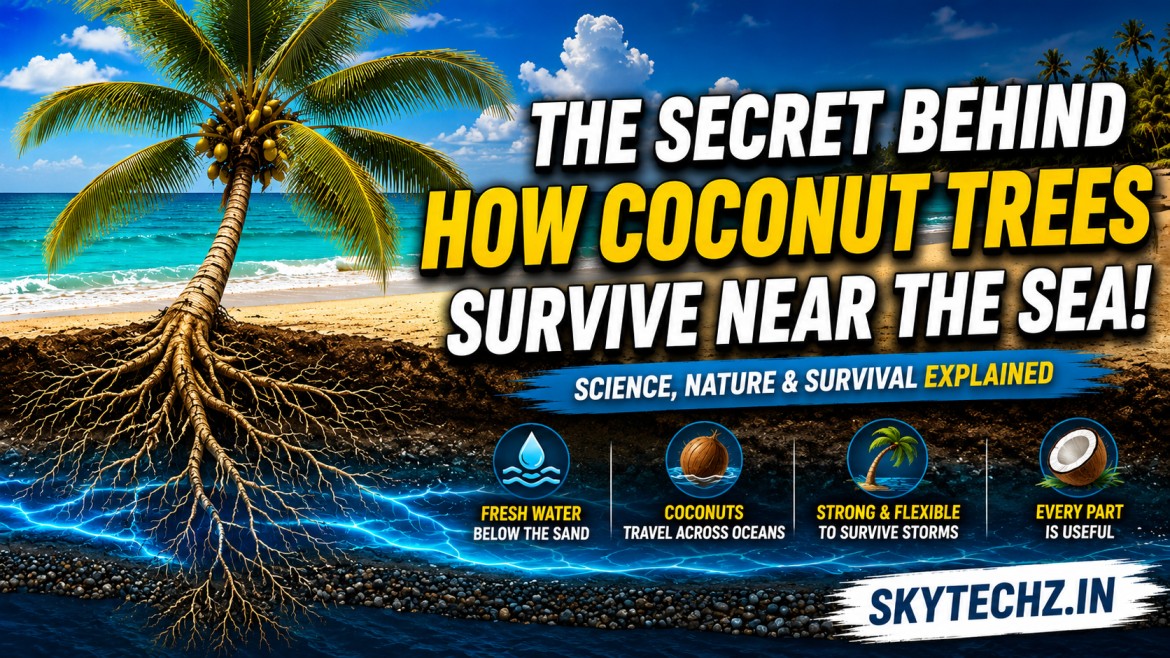
Instead of taking in seawater, coconut trees absorb fresh groundwater stored beneath the sandy beaches.
Where Does the Fresh Water Come From?
Many people think beaches contain only salty water, but that’s not true.
When rain falls, it seeps into the sandy soil and forms a layer of fresh groundwater beneath the surface. Since fresh water is lighter than saltwater, it remains above the underground seawater.
The deep roots of coconut trees naturally reach this freshwater layer and absorb the water needed for growth.
This is the real reason coconut trees can thrive so close to the sea.
Can Coconut Trees Tolerate Salt?
Yes, but only to a certain extent.
Coconut trees are salt-tolerant, not salt-loving. Their roots have natural mechanisms that reduce the amount of salt entering the plant.
However, if they receive only seawater for long periods, they will eventually become weak and may die.
Fresh water is still essential for healthy growth.
The Secret Behind Floating Coconuts
One of the most amazing features of a coconut is its ability to float.
The thick fibrous husk surrounding the coconut contains air pockets that act like a natural life jacket.
When a mature coconut falls into the ocean, it floats instead of sinking. Ocean currents can carry it across hundreds or even thousands of kilometers before it reaches another coastline.
If the coconut lands on suitable soil with enough moisture, it germinates and grows into a new tree.
This natural process has helped coconut trees spread across tropical coastlines around the world.
Why Beaches Are the Perfect Home for Coconut Trees
1. Plenty of Sunlight
Coconut trees need full sunlight to produce food through photosynthesis. Open beaches receive sunlight throughout the day, making them ideal habitats.
2. Excellent Drainage
Sandy soil drains water quickly. Coconut roots do not like standing in water, so well-drained beach sand helps keep the roots healthy.
3. Less Competition
Compared to dense forests, beaches have fewer large plants competing for sunlight, water, and nutrients. This gives coconut trees enough space to grow.
Built to Survive Coastal Storms
Coastal regions often experience powerful winds and cyclones.
Unlike many trees that snap during storms, coconut trees have long, flexible trunks that bend with the wind instead of resisting it.
Their strong root systems anchor them firmly into the sandy soil, helping them survive even severe weather conditions.
How Humans Helped Spread Coconut Trees
Humans also played an important role in spreading coconut trees across the world.
Ancient sailors carried coconuts during long sea journeys because they provided fresh drinking water, nutritious food, natural fiber, and useful shells.
Whenever they reached new islands or coastal regions, they planted coconuts, allowing the trees to spread across Asia, Africa, the Pacific Islands, and the Americas.
Interesting Facts About Coconut Trees
- Coconut trees can live for 60–80 years or more.
- A healthy tree can produce 50 to 100 coconuts every year.
- Every part of the tree has practical uses, including the fruit, trunk, leaves, husk, and shell.
- Coconut palms are often called the “Tree of Life” because they provide food, water, oil, fiber, shelter, and building materials.
- Coconut seeds are among the few seeds capable of surviving long journeys across the ocean.
Environmental Importance of Coconut Trees
Coconut trees are much more than fruit-bearing plants. They play a vital role in protecting coastal ecosystems and maintaining environmental balance.
Their strong and widespread root systems help hold loose sandy soil together, reducing coastal erosion caused by waves, tides, and heavy rainfall. In many tropical countries, rows of coconut trees act as natural barriers that protect beaches from being washed away.
The large leaves of coconut palms provide shade and create a cooler environment around beaches and coastal villages. They also offer shelter and nesting places for birds, insects, crabs, and many other small animals. This makes coconut trees an important part of coastal biodiversity.
By absorbing carbon dioxide from the atmosphere and releasing oxygen, coconut trees also contribute to reducing greenhouse gases and improving air quality.
Economic Importance of Coconut Trees
The coconut tree supports the livelihoods of millions of people across the world. Countries such as India, Indonesia, the Philippines, Sri Lanka, Thailand, and Vietnam produce millions of coconuts every year.
Almost every part of the coconut tree has commercial value. Coconut water is consumed as a natural health drink, while coconut milk and coconut oil are widely used in cooking. The fibrous husk is processed into coir products such as ropes, mattresses, brushes, and eco-friendly gardening materials. Coconut shells are used to make handicrafts, bowls, activated charcoal, and decorative items.
Because every part of the tree can be used, the coconut palm is often called the “Tree of Life.” The global coconut industry generates billions of dollars every year and provides employment to farmers, manufacturers, traders, and exporters.
Challenges Faced by Coconut Trees
Although coconut trees are highly adaptable, they still face several threats. Climate change has increased the frequency of powerful cyclones, prolonged droughts, and rising sea levels, all of which can affect coconut plantations.
Several diseases, including Lethal Yellowing Disease, along with pests such as the Red Palm Weevil, can severely damage coconut trees and reduce fruit production.
Scientists and agricultural experts continue to develop disease-resistant coconut varieties and sustainable farming techniques to protect coconut plantations for future generations.
Interesting Facts About Coconut Trees
- The scientific name of the coconut tree is Cocos nucifera.
- A coconut usually takes about 10 to 12 months to fully mature.
- Coconut water inside an unopened young coconut is naturally sterile.
- A healthy coconut tree can continue producing fruits for more than 60 years.
- Coconut palms are grown in over 90 tropical countries worldwide.
- Botanically, a coconut is a fibrous one-seeded drupe, not a true nut.
- India is one of the world’s largest producers of coconuts.
- Some coconut trees can grow up to 30 meters (100 feet) tall.
Conclusion
The presence of coconut trees along coastlines is not a coincidence. It is the result of millions of years of evolution and natural adaptation.
Although they grow beside the sea, coconut trees do not survive by drinking salty seawater. Instead, they depend on underground fresh water stored beneath sandy beaches. Their salt tolerance, floating coconuts, flexible trunks, and ability to thrive in coastal environments make them one of nature’s greatest success stories.
The next time you visit a beach and see a coconut tree swaying in the sea breeze, remember that it is much more than just a tropical tree—it is a remarkable example of evolution, resilience, and nature’s incredible design.