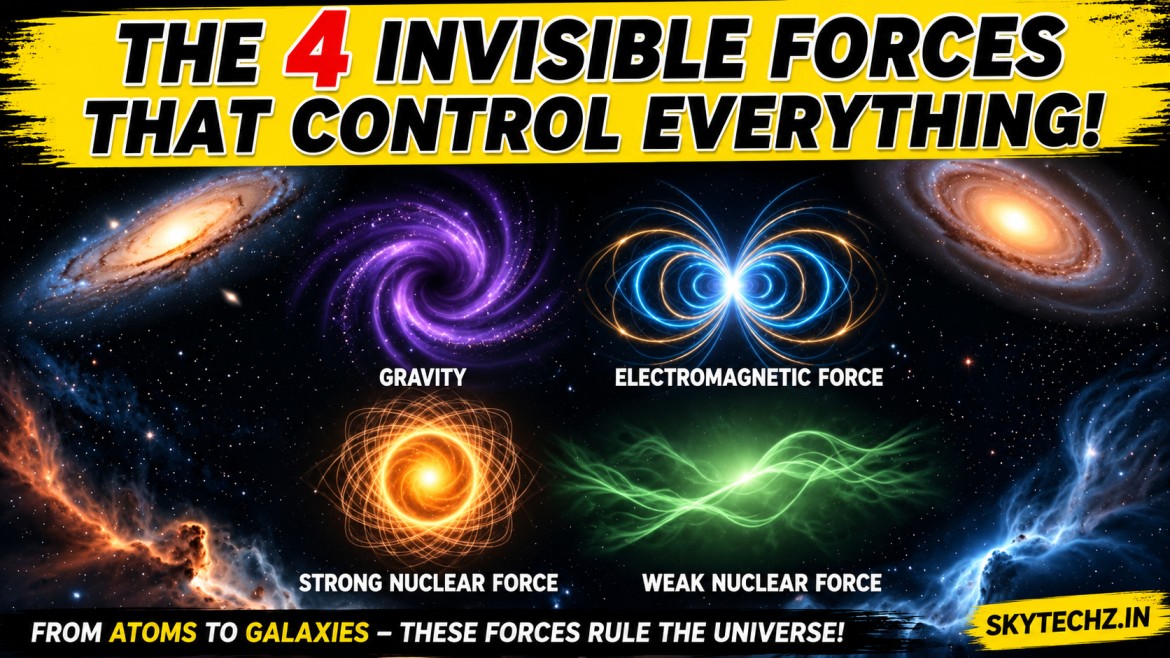
The 4 Fundamental Forces of the Universe Explained: The Invisible Powers That Control Everything
Have you ever wondered what keeps the Earth orbiting the Sun, why atoms stay together, or how stars continue to shine for billions of years?
Ancient Indian philosophy explains that the world is made of five elements—Earth, Water, Fire, Air, and Space (Panchabhutas). While this traditional idea explains nature from a spiritual perspective, modern science explains the universe through four fundamental forces.
According to physics, these four invisible forces control everything—from tiny atoms to giant galaxies. Without them, matter, stars, planets, and even life itself would not exist.
What Are the Four Fundamental Forces?
The four fundamental forces of nature are:
- Gravitational Force
- Electromagnetic Force
- Strong Nuclear Force
- Weak Nuclear Force
Each force has a unique purpose and together they govern the entire universe.
1. Gravitational Force – The Force That Holds the Universe Together
Gravity is the force we experience every day. When an object falls to the ground, gravity is responsible.
Sir Isaac Newton explained that every object with mass attracts every other object through gravity. The greater the mass, the stronger its gravitational pull.
Later, Albert Einstein expanded this idea with his Theory of General Relativity. According to Einstein, massive objects bend the fabric of space-time. This curvature is what we experience as gravity.
Importance of Gravity
- Keeps Earth orbiting the Sun.
- Keeps the Moon orbiting Earth.
- Holds galaxies together.
- Controls the motion of stars and planets.
Although gravity works across billions of kilometres, it is actually the weakest of the four fundamental forces.
2. Electromagnetic Force – The Force Behind Electricity and Light
The electromagnetic force acts between electrically charged particles.
Inside every atom, protons carry a positive charge while electrons carry a negative charge. Opposite charges attract each other, while similar charges repel.
Electricity and magnetism are closely connected. Moving electric charges create magnetic fields, and changing magnetic fields can generate electricity.
Examples of Electromagnetic Force
- Electricity
- Smartphones
- Television
- Computers
- Wi-Fi
- Magnets
- Light
Without electromagnetic force, atoms would not exist and modern technology would be impossible.
At the atomic level, electromagnetic force is approximately 1036 times stronger than gravity.
3. Strong Nuclear Force – The Strongest Force in Nature
Everything around us is made of atoms. Inside the nucleus of an atom are protons and neutrons.
Since protons all carry positive charges, they should repel one another. However, they remain tightly bound because of the Strong Nuclear Force.
This force binds protons and neutrons together and overcomes the electromagnetic repulsion between protons.
Scientists believe gluons carry this force by binding quarks together inside protons and neutrons.
Why Is It Important?
- Holds atomic nuclei together.
- Allows atoms to exist.
- Makes molecules possible.
- Supports the formation of stars, planets, and life.
Without the Strong Nuclear Force, the universe would never have formed.
4. Weak Nuclear Force – The Force That Powers the Sun
The Weak Nuclear Force operates only over an extremely small distance inside atomic nuclei.
Unlike the Strong Nuclear Force, which holds particles together, the Weak Nuclear Force changes one type of particle into another.
It is responsible for radioactive beta decay, where neutrons and protons transform into each other under certain conditions.
Importance of Weak Nuclear Force
- Causes radioactive decay.
- Powers nuclear fusion inside the Sun.
- Produces solar energy.
- Helps create many elements found in nature.
Without this force, the Sun would never shine and life on Earth would not exist.
Comparison of the Four Fundamental Forces
| Force | Relative Strength | Range | Main Function |
|---|---|---|---|
| Strong Nuclear Force | Strongest | Extremely Short | Holds atomic nuclei together |
| Electromagnetic Force | Very Strong | Infinite | Controls electricity, magnetism and light |
| Weak Nuclear Force | Moderate | Extremely Short | Causes radioactive decay and nuclear fusion |
| Gravitational Force | Weakest | Infinite | Attracts objects with mass |
Is There a Fifth Fundamental Force?
Scientists are currently investigating whether a fifth fundamental force exists.
Recent experiments involving muons have shown small anomalies that cannot yet be fully explained by the Standard Model of particle physics. Researchers are also studying dark matter and other unexplained cosmic observations.
Although these findings are exciting, no fifth force has been officially confirmed.
If such a force is discovered in the future, it could completely change our understanding of physics and the universe.
Final Thoughts
The four fundamental forces form the foundation of everything in the universe.
- Gravity keeps planets, moons and galaxies together.
- Electromagnetic Force powers electricity, light and modern technology.
- Strong Nuclear Force binds atomic nuclei.
- Weak Nuclear Force powers the Sun and enables radioactive decay.
Together, these invisible forces make the universe possible. As scientists continue exploring the mysteries of space and matter, future discoveries may reveal even deeper secrets—including the possibility of a fifth fundamental force.
The 4 Fundamental Forces of the Universe Explained: The Invisible Powers That Shape Reality
Have you ever looked up at the night sky and wondered what keeps the Moon orbiting the Earth, why stars continue to shine for billions of years, or how tiny atoms remain stable? Everything we see—from the smallest particle to the largest galaxy—is controlled by invisible forces. Without these forces, the universe would simply not exist.
Ancient Indian philosophy describes the world through the five elements (Panchabhutas): Earth, Water, Fire, Air, and Space. These elements symbolize the balance of nature and life. Modern science, however, explains the physical universe differently. According to physics, the entire cosmos is governed by four fundamental forces. Every movement, every chemical reaction, every star, every planet, and even our own bodies depend on these four forces working together.
Scientists call them the Fundamental Forces of Nature because they are the basic interactions responsible for everything that happens in the universe.
What Are the Four Fundamental Forces?
- Gravitational Force
- Electromagnetic Force
- Strong Nuclear Force
- Weak Nuclear Force
Let’s explore each of these forces in simple language.
1. Gravitational Force – The Force That Holds the Universe Together
Gravity is the most familiar force because we experience it every day. Whenever you drop an object, it falls to the ground because of Earth’s gravity. This force acts between any two objects that have mass.
In the 17th century, Sir Isaac Newton proposed that every object in the universe attracts every other object through gravity. The larger the mass of an object, the stronger its gravitational pull. This idea explained why planets orbit the Sun and why the Moon stays in orbit around the Earth.
Later, Albert Einstein expanded this idea through his Theory of General Relativity. He explained that massive objects bend the fabric of space and time. This curvature creates what we experience as gravity.
Why Gravity Is Important
- Keeps Earth orbiting the Sun.
- Keeps the Moon orbiting Earth.
- Forms stars and galaxies.
- Controls the movement of planets.
- Keeps us firmly on the ground.
Although gravity acts across billions of kilometers, it is the weakest of the four fundamental forces.
2. Electromagnetic Force – The Force Behind Electricity and Light
The electromagnetic force acts between electrically charged particles. Every atom contains positively charged protons and negatively charged electrons. Opposite charges attract while similar charges repel.
Electricity and magnetism are two forms of the same force. Moving electric charges create magnetic fields, while changing magnetic fields generate electricity.
Examples of Electromagnetic Force
- Electricity
- Smartphones
- Computers
- Televisions
- Wi-Fi and Bluetooth
- Electric motors
- Magnets
- Visible light
Without electromagnetic force, atoms could not exist and modern technology would be impossible.
At the atomic level, this force is nearly 1036 times stronger than gravity.
3. Strong Nuclear Force – The Strongest Force in Nature
Everything around us is made of atoms. Inside every atom is a nucleus containing protons and neutrons.
Since protons all carry a positive charge, they should repel each other. However, they remain tightly packed because of the Strong Nuclear Force.
This incredibly powerful force binds protons and neutrons together inside the atomic nucleus, overcoming the electromagnetic repulsion between positively charged protons.
Scientists have discovered that protons and neutrons are made of smaller particles called quarks, which are held together by particles known as gluons.
Importance of the Strong Nuclear Force
- Holds atomic nuclei together.
- Allows atoms to exist.
- Makes molecules possible.
- Supports stars, planets, and life.
Without this force, matter itself would fall apart.
4. Weak Nuclear Force – The Force That Powers the Sun
The Weak Nuclear Force operates over an extremely tiny distance inside atomic nuclei.
Unlike the Strong Nuclear Force, which holds particles together, the Weak Nuclear Force changes one type of particle into another. It is responsible for radioactive beta decay.
This force also plays a crucial role in nuclear fusion inside the Sun, allowing it to produce the energy that supports life on Earth.
Importance of the Weak Nuclear Force
- Causes radioactive decay.
- Powers the Sun through nuclear fusion.
- Helps create many natural elements.
- Maintains nuclear stability.
Although weaker than the Strong Nuclear Force, it is still much stronger than gravity.
How the Four Forces Work Together
Each force has a unique role in maintaining the universe:
- Gravity controls planets, stars, galaxies, and black holes.
- Electromagnetic Force controls electricity, light, chemistry, and technology.
- Strong Nuclear Force keeps atomic nuclei stable.
- Weak Nuclear Force enables radioactive decay and powers stars.
Together, these four forces create the universe as we know it.
Is There a Fifth Fundamental Force?
Scientists are investigating whether a fifth fundamental force exists. Recent studies involving muons and research into dark matter have raised interesting questions that current theories cannot fully answer.
However, there is no confirmed scientific evidence proving the existence of a fifth force. Research continues, and future discoveries may change our understanding of physics.
Conclusion
The four fundamental forces are the invisible foundations of the universe. Gravity shapes galaxies, electromagnetic force powers modern technology, the Strong Nuclear Force holds atoms together, and the Weak Nuclear Force keeps stars shining.
Every object, every living organism, and every galaxy depends on these four forces working together in perfect harmony. As science advances, researchers may uncover even deeper mysteries—including the possibility of a fifth force that could redefine our understanding of the cosmos.